Gaming Over QUIC
QUIC is viable for game networking. Paper at GAME-ON 2026 in Metz.


An empirical evaluation of transport protocols in multiplayer voxel games
Mike Vandersanden, Dries Coenen, Joris Herbots, Wim Lamotte and Peter Quax. Presented at the 27th annual European GAME-ON Conference (GAME-ON 2026), held at the National Engineering School (ENIM) in Metz, France, from 21 to 23 October 2026.
 Paper (UHasselt)
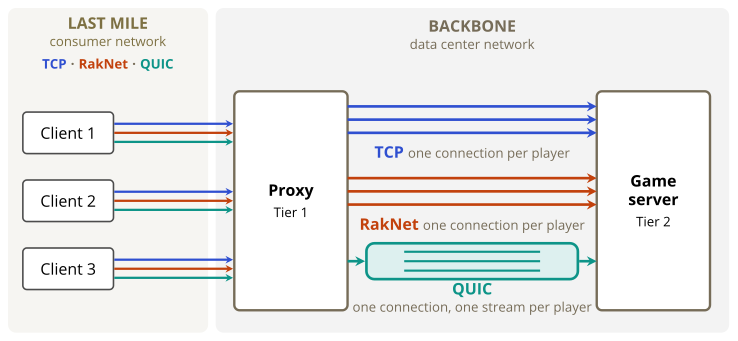
This paper evaluates three transport protocols (TCP, RakNet and QUIC) for game networking in a multi-tier architecture. Players connect over their home network (the last mile) to a regional proxy, which forwards their traffic over a data-center backbone to the game server. Both parts of that path are measured on NetherGames’ production network, with more than 6.9 million measurements.
Results
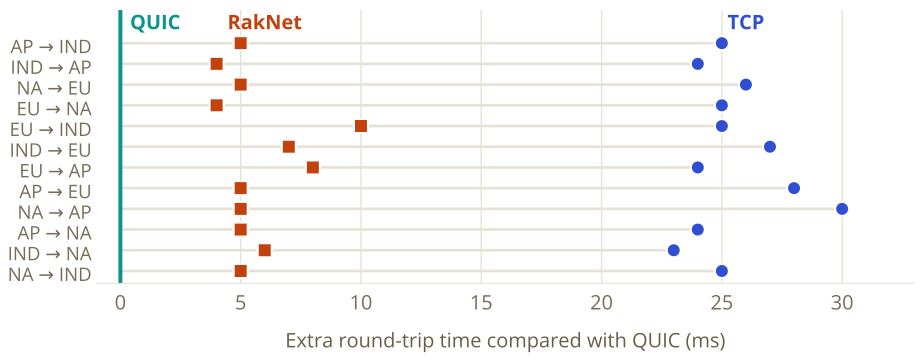
TCP is 23 to 30 ms behind QUIC on every backbone route
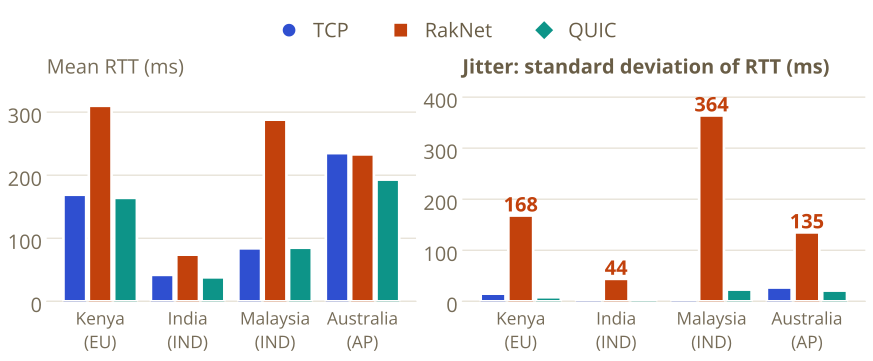
RakNet’s jitter on home links is 6 to 22 times QUIC’s
One QUIC connection can carry all players, one stream each
Between a proxy and a game server, one connection with one stream per player avoids the head-of-line blocking of TCP and the retransmission cascades of RakNet, with a single congestion controller.
Cite
@inproceedings{vandersanden2026gamingoverquic,
  author    = {Vandersanden, Mike and Coenen, Dries and Herbots, Joris and Lamotte, Wim and Quax, Peter},
  title     = {Gaming over {QUIC}: An Empirical Evaluation of Transport Protocols in Multiplayer Voxel Games},
  booktitle = {Proceedings of the 27th European GAME-ON Conference (GAME-ON 2026)},
  address   = {Metz, France},
  year      = {2026},
  month     = oct,
}
 BibTeX
Thanks to the NetherGames team for the infrastructure.
 Links
Links GAME-ON 2026
 QUIC
QUIC